This website has been commissioned by Ipsen Pharmaceuticals Ltd. and is intended for an Irish audience. If you are not a Healthcare Professional, please click here.
Adverse event reporting information is available at the bottom of this webpage.

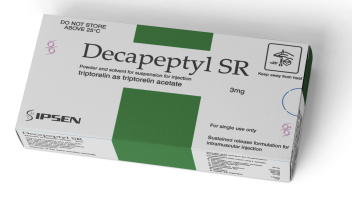
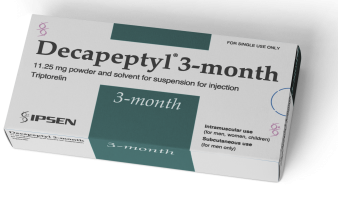
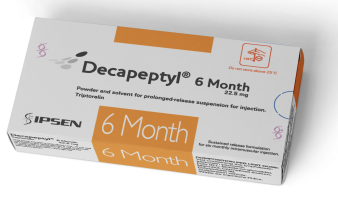
Decapeptyl® (triptorelin) SR 3 mg, Decapeptyl® (triptorelin) 3-month 11.25 mg and Decapeptyl® (triptorelin) 6-month 22.5 mg therapeutic indications.

Decapeptyl® (triptorelin) SR and Decapeptyl® (triptorelin) 3-month are indicated for:

  • Management of advanced prostatic carcinoma.

Decapeptyl® (triptorelin) 6-month is indicated for:

  • Treatment of locally advanced or metastatic.
  • Hormone-dependent prostate cancer.

Decapeptyl® (triptorelin) for prostate cancer treatment


Decapeptyl® indications in prostate cancer are as follows:1-3

  • Locally advanced, non-metastatic prostate cancer, as an alternative to surgical castration
  • Metastatic prostate cancer
  • High-risk localised or locally advanced prostate cancer, as a neoadjuvant treatment prior to radiotherapy
  • Locally advanced prostate cancer at high risk of disease progression, as an adjuvant treatment to radical prostatectomy


Decapeptyl® mechanism of action


Decapeptyl® contains triptorelin, which is a synthetic analogue of luteinising hormone-releasing hormone (LHRH), also known as gonadotrophin-releasing hormone (GnRH).1-3

Triptorelin acts as a potent inhibitor of gonadotropin secretion when given continuously and in therapeutic doses.1-3
After administration of triptorelin, there is an initial and transient increase in circulating levels of luteinising hormone (LH), follicle-stimulating hormone (FSH) and testosterone in males and oestradiol in females.1-3
Continuous and long-term administration of triptorelin, however, results in decreased LH and FSH secretion and suppression of testicular and ovarian steroidogenesis.1-3


Decapeptyl® leads to testosterone suppression in prostate cancer patients

Decapeptyl® mechanism of action
Injection of Decapeptyl® Phase 1 ↑↑ LH, testosterone Potential flare effect
Phase 2
(starting from 2 weeks)
↓↓ LH, testosterone Desensitisation phase


Sustained release formulation

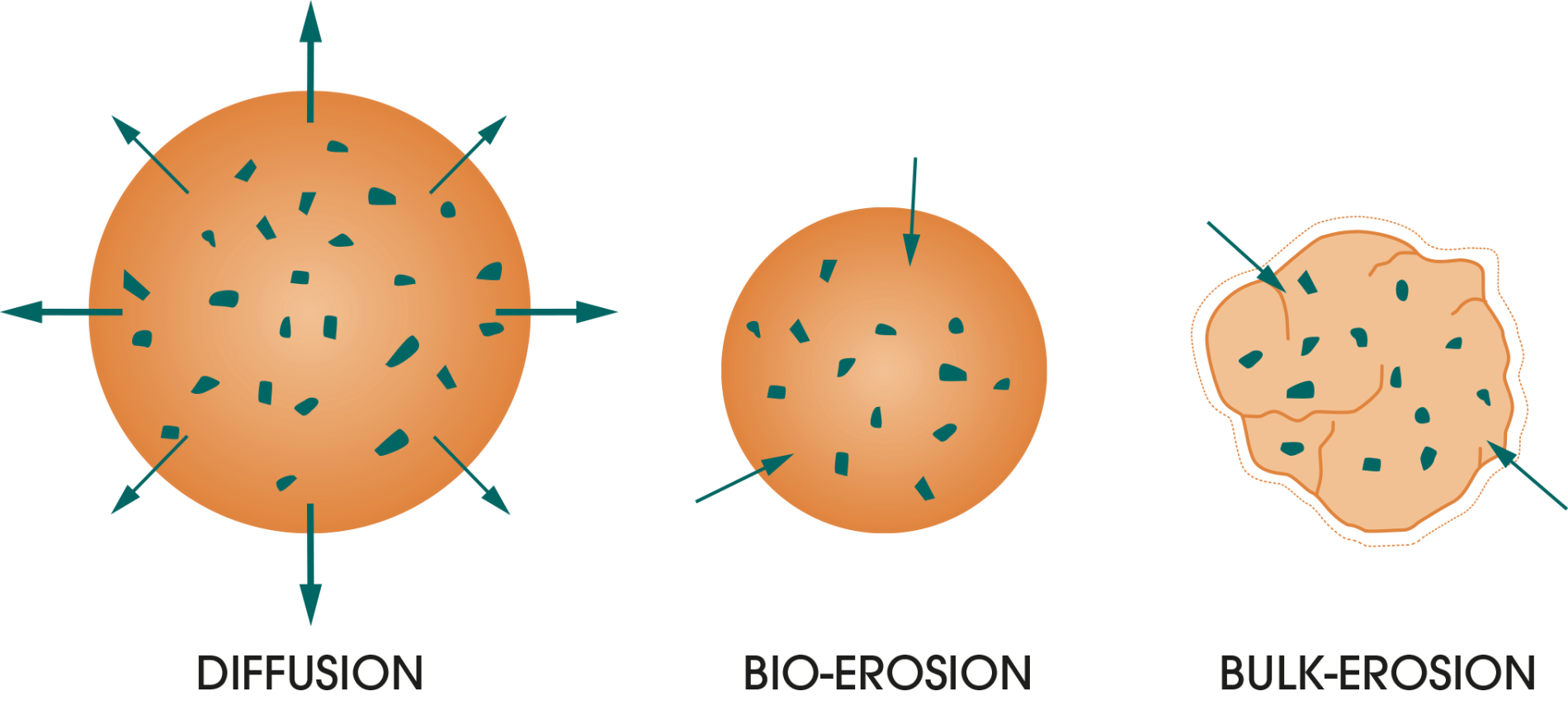
Triptorelin is contained within microspheres that are designed for sustained release.4
Microspheres are spherical particles that consist of a continuous network of support material or polymer in which the active substance is dispersed.


The different stages of triptorelin microsphere breakdown4

Adapted from Tissier et al., 1990.4


Decapeptyl® dosing


Decapeptyl® is a LHRHa with 6-, 3-, and 1-monthly dosage options available in Ireland.1-3

Decapeptyl® releases a steady dose of triptorelin after injection for the dosing period specified. For this reason, select the dosing formulation most appropriate for your patient. Please note two 3-monthly injections given at the same time are not equivalent to giving one 6-monthly injection. The former would result in double the amount of triptorelin being released over 3 months.5

3 mg

A single intramuscular injection every 28 days

3 mg

11.25 mg

A single intramuscular injection every 3 months or subcutaneous (3 monthly only)

11.25 mg

22.5 mg

A single intramuscular every 6 months (24 weeks)

22.5 mg

Decapeptyl® administration

Decapeptyl® is licensed to be administered by a healthcare professional and should not be administered by a patient or carer.


Decapeptyl® preparation and administration video


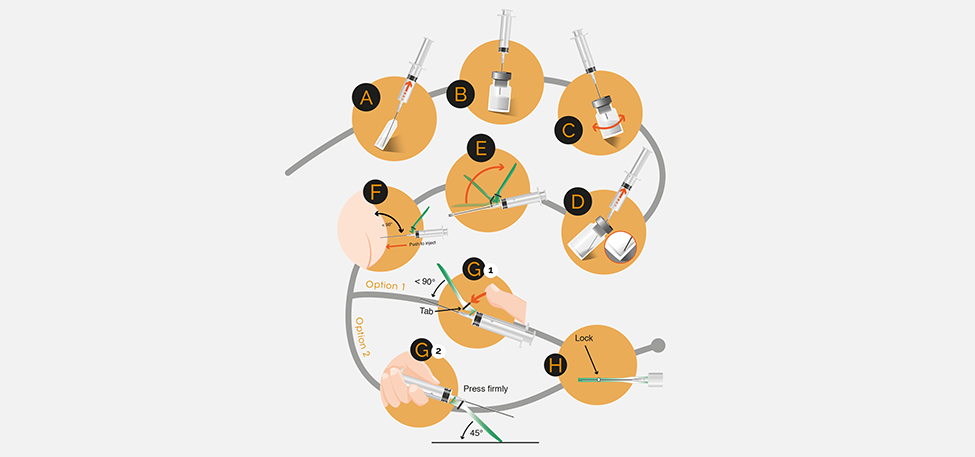
Step-by-step guide to preparing and administering Decapeptyl®


A – Ensure the patient is ready

Ensure the patient is ready for injection. Decapeptyl® must be administered immediately after reconstitution to avoid the product from precipitating and blocking the injection needle.


Prepare the patient by disinfecting the injection site. Break the neck of the ampoule (ensuring the dot faces you).


Draw up all the solvent into the syringe with Needle 1 (needle without the safety device).


Remove the green tab on the top of the vial and insert Needle 1 vertically through the bung.


Transfer the solvent into the vial containing the powder.

B – Pull up Needle 1

Pull up Needle 1 above the liquid level.


Do not remove the needle from the vial.

C – Swirl the vial

Swirl the vial from side to side during mixing with the needle above the liquid level, but do not invert the vial.


Swirl until a homogenous mixture is obtained.


Check there is no unsuspended powder in the vial (if any powder clumps are present, continue swirling until they disappear).

D – Draw up without inverting the vial

Draw up all the suspension without inverting the vial.


A small amount will remain in the vial and should be discarded. An overage is included to allow for this loss.


Remove Needle 1 used for the reconstitution.


Attach the other needle – Needle 2 (needle with the safety device) to the syringe tip (screw on tightly). Only grasp the coloured hub to connect the needle.

E – Move the safety sheath away from the needle

Move the safety sheath away from the needle and towards the syringe barrel.


The safety sheath remains in the position you set.

F – Remove needle protection

Remove the needle protection from the needle.


Prime the needle to remove air from the syringe and inject immediately into the gluteal muscle or other appropriate sites for IM injection.*

G – After injection, activate the safety system

After injection, activate the safety system using a one-handed technique (ensure the finger is kept behind the tab at all times).


Option 1: push the tab forward with the finger.


Option 2: push the sheath to a flat surface.


In both cases, press down with a firm, quick


motion until a distinct audible click is heard.

H – Check the needle is under the lock

Visually confirm that the needle is fully engaged under the lock.


Dispose of the needles as per local requirements.

*The choice is a clinical decision. The injection is usually into a buttock, but other intramuscular injection sites are not excluded.

References

  1. https://www.medicines.ie/medicines/decapeptyl-triporelin-sr-31797/spc Decapeptyl® SR 3 mg Summary of Product Characteristics. Ipsen Pharmaceuticals Ltd.
  2. https://www.medicines.ie/medicines/decapeptyl-triptorelin-3-month-31796/spc Decapeptyl® 11.25 mg Summary of Product Characteristics. Ipsen Pharmaceuticals Ltd.
  3. https://www.medicines.ie/medicines/decapeptyl-6-month-22-5mg-31798/spc Decapeptyl® 22.5 mg Summary of Product Characteristics. Ipsen Pharmaceuticals Ltd.
  4. Tissier B. Drug delivery of peptides. In: Bouchard P, Haour F, Franchimont P, Schatz B, editors. Recent progress on GnRH and gonadal peptides. Elsevier, Paris; 1990. p.159–68.
  5. Ipsen Data on File TRI-UK-004598.

To access relevant information about Prostate Cancer, please choose one of the following options:

Adverse events should be reported.
Reporting forms and information can be found at www.hpra.ie or e-mail medsafety@hpra.ie.
The HPRA can also be contacted on +353 16764971. Adverse events should also be reported to Ipsen via email at pharmacovigilance.uk-ie@ipsen.com or phone on +353 1 8098256.

Reporting of side effects:
If you get any side effects, talk to your doctor, pharmacist or nurse. This includes any possible side effects not listed in the package leaflet. You can also report side effects directly to the HPRA. Reporting forms and information can be found at www.hpra.ie or email medsafety@hpra.ie. Adverse events should also be reported to Ipsen via email at pharmacovigilance.uk-ie@ipsen.com or phone on +353 1 8098256. By reporting side effects, you can help provide more information on the safety of this medicine.